O Divine Dramatist!

O Divine Dramatist!

All the world’s your stage and we your supporting players

written in the timeless comedy and tragedy called life.

With entrances and exits that perplex and mystify,

your scripts have endless chances for crucial parts

and there are no small actors in your productions.

From garden settings

Eden, Gethsemane, and New Jerusalem,

to humble abodes and big city temples,

your plot twists of paradise and peace,

suffering and surrender,

vulnerability and protection abound.

Sometimes in comedy, sometimes in tragedy,

sometimes with protagonists, other times with antagonists,

we find you in every act and every scene:

weeping at our tombs like at Bethany,

drinking at our weddings like at Cana,

healing our Bartimaeus blindness,

challenging our Thomas-like doubts,

stopping our stony judgments and

calming our turbulent seas.

No conflict ever without climactic resolve,

the show (your Passion Play) must go on.

O Playwright of Perfection, come!

Shine your spotlight on the dark stages of our lives;

prompt us to embrace our true and precious roles.

O Gospel Ghostwriter!

O Gospel Ghostwriter!

In the beginning was the Word,

(another name for YOU)

written on the hearts of all your children

but sidelined by abstract thinking and grown-up conflicts.

Then the Word became flesh and dwelt among us,

a light to the human race shining in the darkness

that will never be overcome.

From this fullness all received, grace in place of grace.

Such good news could not be contained!

Synoptic mysteries scribbled on parchment by many

centuries later according to

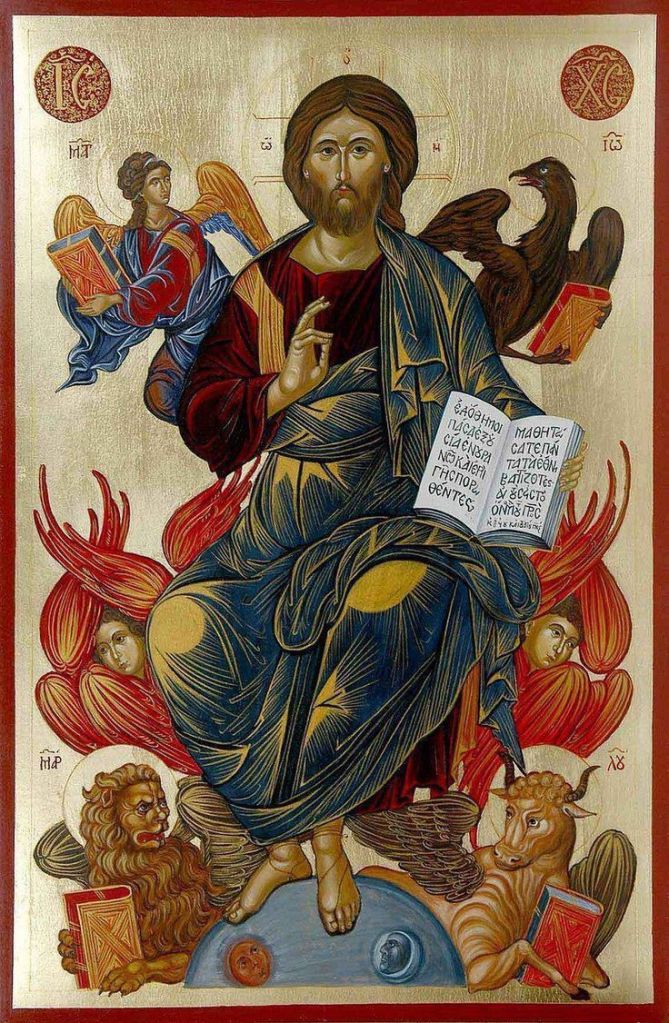
Matthew, Mark, Luke, and John

an angel, a lion, a bull, an eagle (all winged);

Your Word proclaimed from pulpits and sidewalks

beguiling ordinary minds and

enticing scholars to exegete jots and tittles

in search of what they already possess.

O Hidden Autobiographer Come!

Reveal your ever-evolving Word

made manifest in the simple moments of our lives;

immerse us in your testament of love.

O Lyricist!

O Lyricist!

The music of creation sparkles with your love language:

dove’s coo, sparrow’s trill, meadowlark’s call;

cicada’s hiss, cricket’s chirp, frog’s croak.

You comfort our melancholy with your lilting

rain-on-the-roof lullabies.

You expand our vitality with

wind-in-the-trees arias and

thrill our weary souls with

crashing beach waves’ percussion solos.

Better than Rodgers and Hammerstein,

Stephen Sondheim, and Andrew Lloyd Weber

all rolled into one!

(Although your greatness shines through them, too.)

Come O Lyricist for insects, animals, plants and elements!

Lift our disconsolate spirits with your libretto of nature.

O Hidden Journalist!

O Hidden Journalist!

Your unbiassed 24/7 news cycle crawls invisibly across the screen of every enlightened, asleep, or unaware soul.

Underneath angry, stalwart voices 

  who pontificate from social media platforms,

  post stories with artificial intelligence by-lines,

  and in godlike manner peddle truth as fake news,

Your constant reports remain the same:

Blessed are the poor,

as city tents of the unhoused go down.

Blessed are those who mourn,

as civilians and children die by bombs.

Blessed are the meek,

as millionaire athletes and superstars sit on thrones.

Blessed are those who hunger for righteousness,

as protesters collapse under arrest.

Blessed are the merciful,

as refugees remain in border camps.

Blessed are the clean of heart,

as the single-minded suffer mockery.

Blessed are the peacemakers,

as nations polarize.

Blessed are the persecuted,

as innocents die on death row.

Come O Chronicler of Justice!

Break into the cacophony of our big screens

and tiny mobile devices.

Heal our deafness.

Teach us to see.

Attune our hearts to recognize your disguises

and heed your endless pleas.

O Prophetic Poet!

O Prophetic Poet of the Universe,

in each sunrise and sunset

You streak the sky with dazzling metaphors of justice,

the strength of your arm gleaming from goldleaf stanzas.

You scatter the proud in their conceit

with your fuchsia-streaked hair,

Lift up the lowly in glittering ruby slippers,

and nourish the hungry from an Orange Crush fountain.

“Trust me” shines like a simmering silver pendant

around the neck of messenger-bearing clouds.

Your faithful help remains constant

from the pink pulchritude of dawn

to the verdant gloaming of dusk.

Come O Creator of form and beauty,

help us remember your promise of mercy:

every generation that blesses will be blessed!

Time to Say “Oh!” Again

My favorite time of the Advent season has arrived! Time to say “Oh!” again as we pray the ancient “O Antiphons” the week before celebrating the Incarnation. I look forward to this week perhaps as much as the Twelve Days of Christmas. The week before December 25th, during the Liturgy of the Hours, we contemplate and reflect upon the ancient names for the Messiah intoned in the hymn, “O Come O Come Emmanuel”: O Wisdom, O Adonai, O Flower of Jesse, O Key of David, O Radiant Dawn, O King of All Nations, and O Emmanuel.

To me, the “Oh” sounds like the dawning of a spiritual insight– the “aha” moment when the reconciliation of opposites makes perfect sense. For several thousand years before the appearance of Jesus, ancient people of faith were calling out these names, longing for liberation from the captivity of the human condition. Throughout the ages, the past, present, and future meld together in a flash of light, whether felt or ignored, changing the trajectory of history.

Starting with the Big Bang, the first Incarnation took place, and “Wisdom walked on the land.” Adonai gave us the divine law of love in the form of a burning bush. The prophet Jesse’s family roots would bring forth the House of David, the sacred key that would unlock the doors of ignorance and could never be shut. An inextinguishable Light, called “Radiant Dawn” or “Dayspring,” would beckon all to its luminous warmth. And then, the Messiah would come, not in secular power or glory, but disguised as a helpless infant, a hidden King of All Nations, to become “Emmanuel,” God with us, the timeless cornerstone of history.

Last year, I was encouraged to write my own O Antiphons and did so with great relish. In the spirit of repurposing (my Christmas theme this year), I will repost each one with a few embellishments in the next seven days.

May all of us enter the final week of Advent with faith, hope, and love, three virtues the world needs more than ever right now.

O Ancient Storyteller!

O Ancient Storyteller,

author of pithy parables about lost sheep,

hidden coins, and mustard seeds,

the account of your birth still captivates

our twenty-first century technology-driven culture.

By your life, death, and resurrection,

you inscribe deep meaning into suffering,

and transform mortality with happily forever after.

Your story is our story.

Come, O Teller of Tales,

help us find the chapters of our lives

hidden inside yours.

Meaning in the Moments

Long ago in college, I saw a poster on the wall just outside my philosophy class with these words in boldface: DO YOU HAVE UNANSWERED QUESTIONS? The flyer gave students instructions on how to make appointments with counselors and the like. A wisecracker wrote this reply underneath: WHAT IS THE MEANING OF LIFE? That memory has remained with me throughout the years and speaks to an age-old question we can only begin to answer by becoming intentional seekers.

In the old days, before the internet, people sought meaning in large institutions, communities of faith, successful businesses, and charismatic people. Unfortunately, many were bitterly disappointed when fatal flaws revealed themselves and exited these previous holders of inspiration and truth. Many young seekers of meaning today turn to Google or social media platforms rather than consulting wise elders or teachers. The World Wide Web lures us down endless rabbit holes of artificial intelligence disguised as harbingers of truth. Unfortunately, the bi-products of these non-human entities beget increased feelings of skepticism, alienation, and emptiness.

From the beginning of time, saints and sages have written, proclaimed, and shown us that a meaningful life cannot be found outside ourselves, rather, it requires an inside job, beginning with the cultivation of humility. We must admit we don’t have all the answers and need wisdom guides to teach us how to launch and navigate the rough waters of the spiritual life. Fortunately, spiritual directors dedicate their lives as midwives to this birthing process. But then it is up to the individual to tenaciously stay on the quest and find others with similar desires. That’s the hard part.

I have a dear friend who has been suffering her whole life with spina bifada. She was able to manage the pain and inconveniences of the illness for decades but now spends most of her days confined to her home. I have never met a more courageous, positive person as she manages the unimaginable. How does she, and so many others with chronic pain, find meaning in suffering? Another age-old question we are currently pondering together. Reason falls short here, but not so the mystical way which centers in the heart and flows out of Love (just another name for God).

The mystical teachings, recorded in Scripture and many other sacred writings, proclaim that meaning surrounds us in the air we breathe, in ordinary, mundane moments of doing laundry, staying up all night with a crying baby, gazing at the leaves falling from the trees in autumn and yes, even in the pain and death we all inevitably endure. Why do so many of us miss this simple good news? Because, unfortunately, we are pathologically busy and distracted. Fortunately, increased attentiveness and heightened appreciation can be cultivated if we take a few minutes each day to pause, breathe, be silent, and say thank you. Then, no matter what happens in the world around us, meaning arises in all the interior, quiet moments; and beloved teachers and companions appear to help us hold the tension.

Scribe for a Week

Recently, at the request of a dear friend, I became a temporary scribe for a week. Maybe not quite of biblical and monastic levels, but equally challenging. Would I calligraphy a wedding toast on a parchment scroll for her grandson? I was immediately intrigued by this out-of-the-blue request. One of my big laments these days opines over the demise of handwritten anything. Misgivings immediately arose since my hands are not as steady as they once were. The spirit was willing, the flesh weak. Nonetheless, out of sheer love for my friend, I pushed aside my frailties and took on the task.

I became fascinated with hand-writing as an art form when I was quite young and would amuse myself by copying Old English script, modern block letters, and finally the art of calligraphy before “font” became everyday jargon. My vast collection of fountain pens and nibs occupies a whole drawer in my desk. I love the smell of bottled ink in the morning! Throughout the years, people frequently affirm my handwritten cards and notes. “I wish I had a pen that could write like that,” they exclaim. While I could easily supply one, a person who can push that pen is also required. Ah, there’s the rub. While professional calligraphers skilled in this technique still exist, amateurs like me are apparently a dying breed. When was the last time you received a beautifully hand-written anything?

Eagerly, I set up my drafting tools–rulers, pencils, erasers, and a splendid array of pens and ink bottles. Maybe I should don a cowl and robe, I thought. I laughed aloud, picturing monks in monasteries hunched over ancient scrolls. Instead, I utilized technology and made a playlist of meditative music to help me concentrate. The toast, emailed to me, was four pages long, single-spaced, and in 11-point font. Yikes! I copied it into a Word doc to calculate the number of lines needed, how many words would fit on a line, etc. The preparation alone took many hours. Meanwhile, the weather turned HOT. I set up fans since we don’t have air-conditioning in Dana Point and wrote multiple paragraphs on scrap paper for practice. Like an Olympian, I knew I had only one shot. The margin of error was high and there was no turning back once begun.

Since large wooden dowels were affixed to the scroll on each end, I stood up to do the calligraphy. I often paused to stretch my back, shake out my legs, and breathe deeply. Copying a document word-for-word poses a unique challenge beyond the physical demands. What do you do with lapses in concentration when words are misspelled, left out, or inserted? Human error! I had to create new words, edit nonsequiturs, and figure out how to disguise lettering mistakes. An artist friend reminded me that the beautiful illuminated medieval manuscripts covered up a plethora of human errors so I did not feel so bad.

The experience also gave rise to daily meditations about our ancient, sacred sources and the amount of time and ink spilled by scholars arguing over translations and interpretations of the early texts. What influence did the scribes have in what eventually got written down and later taken by some as literal truth? Who were the “fact checkers” in the scriptoriums of yesteryear? A previous realization about Divine Revelation recurred. What we ultimately believe about Scripture, inspired by words written long ago in dimly lit rooms by well-meaning but very human artists, comes down to a leap of faith, tested by experience, known more in the heart than in the head.

When I finished the calligraphy, I was relieved when the number of calculated lines fit the manuscript nicely onto the five-page scroll. I was simultaneously dismayed over the mistakes, smudges, and lettering flaws that leaped up at me. My heart sank. Was this good enough? When I conveyed my misgivings to a friend, she reassured me. “That’s the charm and beauty of what is hand-done. Trust the Spirit. That’s what the early Scribes did when they embraced this human and divine work.” I felt an instant resonation stir within me. In our current culture of AI, fake news, and a veneer of perfectionism on social media, nothing can replace the sacramental, incarnational nature of the human touch, flaws and all.

Scribe for a week left me humbly grateful. The process, despite my woefully inadequate feelings, provided yet another chance to exercise my both human (in execution) and divine (in intention) nature. Turns out, the scroll, a gift for someone I have never met, became a gift for me, full of insights and meaning. What could be better?

It’s All About The Cake

Last week, I made a three tiered wedding cake for a very special young woman (aptly named Grace) who has been in my life since her birth. While baking cakes for family celebrations is nothing new for me, this was a first. An entire seven days were devoted to preparing the many layers of vanilla cake from scratch plus a strawberry curd filling and buttercream frosting. I made multiple sketches, endless lists of needed tools, and watched a plethora of YouTube videos on how the professionals transport these confectionary masterpieces. After multiple Amazon purchases and daily runs to the grocery store and Costco, my admiration for those who do this for a living soared to new heights.

When I told friends that I was baking the wedding cake, they seemed nonplussed and concerned. Why was I subjecting myself to this herculean task? At my age? Why not just pay a bakery? I found simple explanations difficult. “Love” was my simple go-to answer. More than anything, I wanted to do something meaningful for my “chosen” niece (her mom, Mary, is my “chosen sister”). Cooking and feeding people tops my list of meaningful activities. These sacred, sacramental moments, created when people come together at table, elevate ordinary meals to sublime experiences.

With ample time to listen to classical music and ponder deeper connections, I eagerly entered the chapel of my small galley kitchen each day with an open heart. I prayed a benediction over each stick of butter, every cup of flour and sugar; I anointed every batter and bowl of frosting with homemade vanilla. Litanies of praise erupted as the cakes rose in the oven and slipped easily out of the pans. Prayers of gratitude poured out when the strawberry curd thickened to perfection and the butter and powdered sugar magically turned into fluffy pillows of frosting. The day before the wedding, a dear friend came to keep vigil with me as I filled the layers, did a crumb coat, refrigerated, then frosted each tier with swirly texture and anchored the centers with plastic straws. Together, we chanted our faith, hope, and love for a batch made in heaven.

The next day, after assembling the cake before the reception and later placing it on a special table, I gazed at the guests who came together to show their deep affection and support. Timeless love and wisdom radiated just below the surface of obligatory small talk and cultural expectations. Eucharistic words came to mind: take, break, eat, and share. Take the abundant love you feel this day; allow it to break open your heart; become the food of love you eat; go out into the world and share that love with everyone. Experience thanksgiving on this first Saturday in August.

After all those days of preparation, the cake was devoured in minutes. Everyone loved it, especially me, who took unspeakable joy seeing how much people still relish this traditional ritual. Indeed, I thought, it’s all about the cake. And love. And life. And a community of real presence, offering a safety net for a beautiful young couple who pledged their everlasting vows on a warm summer evening.