Spiritual Muses

Each year I am struck by the increasing popularity of Halloween and Dia de Los Muertos. Weeks before October 31, yards are lit up with orange lights, huge blow-ups of pumpkins, ghosts, ghouls, and projected images that cover garage doors, etc. In my daughter’s neighborhood with dozens of young families, there will be games and haunted houses for the children on Halloween night. The celebrations seem to be getting more elaborate by the year

Dia de Los Muertos (the Day of the Dead), is also more prevalent these days with skeleton figurines of everything from Elvis playing his guitar to smiling cats and whimsical dogs sold prominently in even discount stores. The movie “Coco” has reinforced remembering the dead with catchy songs and brilliant animation. Colorful ofrendas (altars dedicated to dead relatives) with their sunny marigolds and papel picado (perforated paper) appear not only in churches but also in many homes and yards.

What continues to capture our imagination during these days in the waning of October? When these traditions began, the primitive world was trying to figure out the proper attitude toward death and the possibility of an afterlife. From the earliest dawning of civilization, there have been rituals and celebrations for those who have gone before us. Eventually, Christian culture reinvented these celebrations with the Holy Days known as All Saints Day (November 1) and All Souls Day (November 2). Catholics consider these days sacred and still observe them by attending Mass and praying for the dead.

The veneration of the saints has always been confounding to many Protestants and non-believers. They think Catholics are being superstitious or even worse, idolatrous, when we invoke our holy ancestors, asking them to pray for us or fix some troublesome situation. Many ask us why we pray for the dead when there are only two final places, heaven and hell, beyond our influence after death. While it is true that some of us may be superstitious or prefer to remain dualistic about the spiritual world, there is another layer to this connection between heaven and earth worthy of consideration.

In my view, when remembering and venerating the dead, we are simply searching for spiritual muses to inspire our lives. The witnesses of remarkable holy people can fascinate and sustain us through the tough realities of ordinary existence. They stoke the embers of faith inside our needy souls. Some even light the fires that change the course of history centuries later. Think Joan of Arc, Francis of Assisi, Mother Teresa, Desmond Tutu, Dorothy Day, Nelson Mandela, Pope John Paul II, and countless others. I think we need these spiritual muses to mentor us in Wisdom’s ways. While their bodies have departed this world, their presence flows through us and provides the needed inspiration for a better life.

Perhaps some of you are thinking that our current celebrations of Halloween and the Day of the Dead are a far cry from what I am proposing here. I am not naive–I know very well that loads of money will be made from all the decorations, costumes, and candy sold. Nonetheless, as in all of the outer trappings of capitalism, there is a divine thread that connects superficiality with a deep well of meaning. That is where I choose to abide. Enjoy these coming days dedicated to those who have gone before us and may you be inspired to become a spiritual muse for future generations!

Close Encounters

I walk my Golden Retriever, Wylie, every afternoon. We know every inch of our neighborhood as well as the enjoining community. Creatures of habit, we stop at the same places and know every tree, succulent, rosebush, and home improvement. I try to be surprised by the little subtleties of the changing seasons, but I admit I am often listening to music or audiobooks while I walk which can be distracting. I find this curiously paradoxical because I am always praying to find the inspiration to be more mindful and to luxuriate in the present moment. Creatures of dissonance, that is, doing the opposite of what we say we desire, we sometimes have to be shaken out of our routine to get our focus back. Close encounters with wildlife did it for me recently!

Our neighborhood in Dana Point is on the edge of a canyon. It was a lot wilder years ago when families of skunks freely scampered over the sidewalks, possums did tightrope walks on fences at night, and garden snakes coiled on our front doorstep. Nowadays, urban sprawl has changed the habitats of so many native creatures. Some wildlife have disappeared and some have become more urbanized, giving rise to new fears. Snapshots of coyotes scaling backyard fences and leering at us from behind bushes, augment our frenzy for the safety of small animals. When cats and small dogs disapper, we are quick to blame even though we both share the survival instinct.

I have encountered many coyotes over the years but never like last week when one suddenly came nose-to-nose with my four-legged companion during our daily stroll on the edge of the canyon. It was such a sudden close encounter, I did exactly what I knew NOT to do, I yanked the leash and we ran. Then I learned why we are cautioned never to run from a coyote because he followed us down the sidewalk, head down, definitely tracking our every move. I stopped running but not my quickened pace toward the busy intersection just ahead. I knew coyotes are skittish of traffic. Fight or flight? Well, I found out which one is more instinctual as shots of adrenal coursed through my veins. It occurred to me later that I should have probably been more afraid of the cars.

Fear, the predator that stalks literally every human being in one form or another, both motivates and paralyzes even the most stalwart of us. Perhaps the most common topic of conversation during spiritiual direction, anxiety, fear’s first cousin, lies barely beneath the surface of our consciousness. The horror of the pandemic, civil rights unrest, the war in Ukraine, political divisions, health issues, etc., make serenity a serious chore these days. Although I have spent a fair amount of time cultivating meditation, deep breathing, and resting in God, my close enounter with that coyote reminded me that I am still a work in progress. Surrender into the arms of a loving God remains intermittentlly elusive and the object of my deepest longing.

Two days after my close encounter with the coyote, I was visiting my grandchildren in Rancho Santa Margarita when we were graced with the presence of a California Condor, in all his vulture-like glory, perched on their backyard fence. Awed by the sheer size and “otherness” of this magnificent predator, we gazed at it for a long time until he spread his enormous wings, took off like a stealth bomber, and floated on the wind, searching for lunch in the canyon wilderness they share. I felt no fear then, only wonder and awe. Inspired again by the Creator, my heart cried out, and I fled into the arms of mystery.

Do It Yourself

I know what it’s like now to be a day laborer. No, this is not a new job nor some outside-the-home volunteer effort. Rather, I have been slaving over a “do-it-yourself” backyard project. Mind you, this is not the first time I have embarked on this type of endeavor. However, it has been many years since a task of this magnitude occupied my complete attention and made me feel just a wee bit overwhelmed. Let’s just say I underestimated the toil, never mind the heat wave, when I enthusiastically decided, about six weeks ago, to finish a big landscaping project myself.

The vision to forge a dual path, made out of cobblestones, to connect the two previously landscaped areas in my large backyard has haunted me every day for the past several years. The project also included relocating and/or repotting some plants and rocks, filling empty spots with drought-resistant varieties, and laying down some turf to conserve water. Admittedly, I procrastinated, anticipating the amount of work and effort this would take. The decision to finally go forward came after many months of gazing at the space, dreaming, pondering, and planning. Hiring strong folks to actually do the work was seriously considered but the still small voice inside stirred me. I have the time, the work seemed doable, the physical test an enticing challenge. I wanted to see if I still had the mettle, like my two-year-old grandchild, to “do it myself!”

Throughout the weeks of toil, I told myself that the ground preparation, heavy lifting and placing of the cobblestones, moving debris, sweating, and sore muscles were good for me. I do love working outside–although not so much when the temperature reaches an unprecedented 90 degrees in our little beach town where we boast of not needing air-conditioning. Do not fear, I drank gallons of ice water, got up early, and did most of the work in the shade. I looked at it through a spiritual lens: I was forging a path that had never been there before. Obviously, that required effort but it would be worth it in the end.

Fortunately, I never felt overburdened. I listened to audible books, podcasts, and music every step of the way. I prayed my way through large parts of the job listening to Gregorian Chant and my favorite meditation selections. My thought was if I was forging a path, then it would be one built of love as much as blood, sweat, and tears.

The process made me think about the stages of faith, the connection between work and prayer (very monastic), and the closeness to the dirt reminded me of “earthy mysticism,” my favorite brand of contemplation. For many hours, working alone in silence and solitude, so close to terra firma, I could sense the Presence of the Spirit and the communion of saints, a “cloud of witnesses” urging me on. Suddenly it dawned on me that there is really no such thing as DIY with such spiritual companionship surrounding my every move.

I know my family and friends thought I was a little crazy but that was all right. I feel a sense of personal accomplishment when I walk the pathway now and see both beauty and imperfection in the end result. The words of Julian of Norwich float through my consciousness and give me great consolation: “Be a Gardener. Dig a ditch. Toil and sweat. And turn the earth upside down. And seek the deepness. And water plants in time. Continue this labor. And make sweet floods to run, and noble and abundant fruits to spring. Take this food and drink, and carry it to God as your true worship.

Holy Insomnia

“Everybody Sleeps,” was a video lesson shown for years on the children’s television show “Sesame Street.” With quiet music playing, images of birds, animals, and people flowed across the screen in beautiful synchronicity. I remember with pleasure the times I watched this sweet sequence with my children when they were very young. I wanted them to know how important it was for everyone to rest, even adults like Mommy and Daddy, who were often in the throes of parental sleep deprivation.

Medical experts warn us that adults consistently need at least eight hours of sleep every night to remain healthy. However, bouts of insomnia commonly afflict as we face stress and aging, depriving many of reaching that magic number. Not surprisingly, sleeplessness has risen dramatically and become a common malady especially since the pandemic. Rather than acceptance of the inevitable, many are frightened and anxious, increasing the probability of more sleepless nights and addiction to pills and alcohol as the antidote.

In truth, some are simply more prone to insomnia than others. Unfortunately, I fall in that category. I used to be ashamed to admit it, conditioned to believe I couldn’t sleep because of a “guilty conscience.” Gratefully, my consciousness has been raised. Yet, I am still perplexed when I wake up in the middle of the night (usually around 3:00 a.m.) and cannot easily go back to sleep. Rather than reverting to sleep aids, I learned spiritual techniques to help me face these dark intervals. Like a monk who gets up for”None,” the ninth hour prayer, insomnia calls me to do an unconventional Liturgy of the Hours without switching on a light or using a breviary. I simply prop the pillows around me, pull myself into a semi-sitting position, breathe deeply, repeat my sacred word, and then slowly visualize all who have asked me to pray for them. Most of the time, I fall back asleep, carrying someone on the “royal road” of my dream world.

Recently, while re-reading some of the spiritual classics on my newly ordered bookshelves, I came across the this quote from Thomas Merton, one of my spiritual mentors: “Insomnia can become a form of contemplation. You just lie there, inert, helpless, alone, in the dark, and let yourself be crushed by the inscrutable tyranny of time. The plank bed becomes an altar and you lie there without trying to understand any longer in what sense you can be called a sacrifice.” (Thomas Merton, The Sign of Jonas)

Apparently, even monks are insomniacs. What strikes me so profoundly is calling his bed an altar and surrendering to the mystery of sacrifice. In the surrounding passages of the book, Merton suggests that rather than fight the process, we can offer our sleeplessness for the good of others. One of Merton’s persistant themes, the connectivity of all living things, comes into sharper focus here. Perhaps because of our unity, he conjectures, laying prone on the altar of insomnia with love and compassion may help an unknown someone in the world to experience blessed sleep.

What an uplifting thought! If Merton is right, then maybe a great night’s sleep is merely the grace flowing from the insomnia of a stranger. In either case, every moment, even the frustrating ones, are holy.

Rebirth

In the not-so-distant past, there was excessive Christian conjecture about the absolute necessity of having a once-and-for-all experience of being “reborn.” That kind of discourse always soured me. Even though I had been through a life-altering spiritual awakening and did, at times, feel that ethereal sense of being made new, I never considered this a “done deal,” as the kids say. My experiences of rebirth were always exceedingly brief as I took three steps forward and two back on the spiritual highway; and the deep yearning for new life seemed never-ending.

Once, during my early spiritual evolution, I met a wise woman who delightedly discussed this topic at length with me. Besides dispelling my trepidation that I was somehow “doing it wrong,” she emphasized the importance of ritual when trying to embrace the deep mysteries of life. She invited me to try something new, that is, to embody a prayer, rather than simply using words. She explained that every year, on the Feast of the Assumption of Mary (August 15) she went to the beach so that she could float in the salty ocean which she called “the amniotic fluid of Mary’s womb,” in order to feel ritually reborn. I remember being gob-smacked by this revelation. Although her statement did seem rather weird to me then, I intuitively knew she had spoken some deep truth. When we parted, I could not stop thinking about her suggestion and decided that the only reasonable response was to enter into the ritual and test its veracity for myself.

Without any specific direction, (I was no longer in touch with this fleeting mentor), I simply went to the beach alone on that first August 15th long ago. As I transfixed my gaze at the water, I thought about the connection between the resurrection and the assumption, and my great longing for the permanent body-mind-spirit rebirth promised to all of us. I asked Mary for guidance and visualized her beckoning me into the water. Slowly wading in, allowing the waves to rhythmically hit me, I felt pulled into something deeper. Soon my body was floating weightlessly around in the brine and I did indeed begin to feel like a baby again, held in the timeless womb of Mary. When I emerged from the sea, grounded in the sand, I felt a great release of tension, and like after the birthing process, felt serenely aglow with new life.

I have repeated a version of this ritual every year since, sometimes alone and sometimes in the company of others, but the power of the experience always fills me wonder. On Monday morning (August 15th) about a dozen friends gathered at Doheny State Beach to share this beautiful ritual with me. We listened to music, pondered some readings, and then with intentional, contemplative silence, strolled to the water’s edge and entered into “the amniotic fluid of Mary’s womb.” Surfers were perched on their boards, kids of all ages were playing tag with the waves, and lovers strolled the beach hand-in-hand as we silently pondered, prayed, waded into the depths, and spread rose petals on the water.

Surrounded with overflowing grace, the healing water of the ocean worked its alchemy once more. All were buoyed up by beautiful simplicity and moored onto a metaphoric divine quay. Reborn by water and Spirit, we then returned to the ordinariness of life with the lightness of a child making sandcastles on the shore.

Healing Waters

One year ago, a brilliant soulmate died in the Sequoia National Park while on a hike with his daughter and two other friends. Greg Wise was a man full of life, big-hearted, creatively gifted, and deeply spiritual. Anyone who made his acquaintance knew him instantly because he “never met a stranger,” and was always authentically himself. News of his death took my breath away. I could not imagine life without Greg in the midst of it, constantly cheering me on, as he had for over thirty years. His wife, Mary Kay, (his “beloved” as he often called her), was at home when this happened. Since we have long been soul sisters, I was asked, along with another close friend, to go and break the tragic news to her. It was a horrific night of copious tears, stories, and laughter too as we sat in vigil waiting for the hikers to return home, trying valiantly to get a grip on this awful reality.

I am no stranger to grief. From my early teens, I have witnessed many tragedies and I never get used to the shock–perhaps no one ever does. However, life has taught me that it is possible to make peace with even the most egregious loss. This peace, or healing, comes gradually. The process cannot be rushed, nor does it follow a straight-line pattern. Memories swell at unexpected moments as life returns to “normal.” Right in the midst of the most quotidian task, anger, sadness, fear, and love intensely engulf the soul. But soon grace lands like a butterfly, sunlight streams through the clouds, and the feeling that it is good to be alive gently lifts the pain. We can, and do, find the strength to go on.

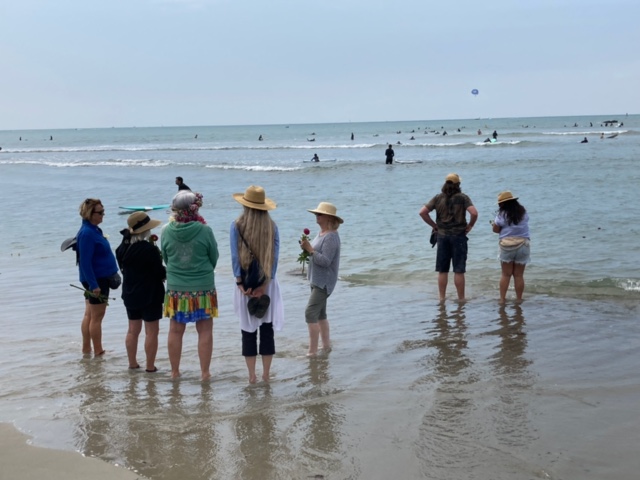
Ritual is a tremendous help in this healing process. To mark the year’s anniversary, Greg’s family and friends gathered at Doheny State Beach for a “paddle out” to mark both his passing and spiritual presence among us. Borrowing from the Hawaiian tradition, astride surfboards, friends paddled out to the end of the jetty, formed a circle, spoke words of love, and threw flowers and leis into the water in Greg’s memory. I do not surf but, like so many who live here, think of the ocean as a therapeutic healing place. The briny smell, the soft sand, and the sound of the waves on the shore are transformational. The salty sea, like a comforting womb, absorbs grief into its vast depths and connects us to the Divine Physician whose presence is palpable.

Many friends, neighbors, and mere acquaintances were at the gathering. I noticed that the somberness of past months had been replaced by a kind of radiance that especially shone from the faces of Mary Kay and her daughter, Mo. Love was in the air! Curiously, I learned that some only knew Greg through his weekly writings on the parish social media sites. He was an inspiring and challenging writer, sometimes criticized because of his stridency on social justice. I can still hear his emotionally choked voice telling me how much he loved and cared for the poor and how little he thought was being done to help them. I hear him punctuating conversations with his devotion to God, all the while struggling with the world’s hypocrisy that seemed to invade his soul. I also hear him laughing at life’s absurdities and telling everyone to risk all for love.

The vastness of the ocean always draws my eyes to the vanishing point that stretches miles out to sea. Fr. Ron Rolheiser teaches that if we keep our vision on what he calls the “infinite horizon,” or the “horizon of the Creator,” the disappointments and tragedies of life are all bearable. In essence, if we strive to always perceive “the bigger picture,” then even our deepest grief is mitigated. I streamed these thoughts and prayers toward the circle of surfers and looked at the beautiful flowers floating so gracefully on the water that bore witness to the cycle of life. Despite the inevitability of death, every day begs for our reverence and gratitude. Greg’s smile then came to mind because I know he knew. Then I smiled and turned my face toward the sun.

Ex Libris

No secret to anyone who knows me, I love books; not only reading them but also collecting and surrounding myself with them. While I have culled my personal library many times, the volumes that remain have been calling for attention ever since I retired last September when hundreds more were added to my overflowing shelves. “Order! We need order!” they seemed to exclaim every time I ran a dustcloth over the twelve bookcases that line every room, now doubled up. “I hear you,” I whispered, then procrastinated. Such an overwhelming task! For months I simply stared at the disarray. Plain and simple, I needed help. Two weeks ago, I asked my oldest granddaughter, home from UCLA for the summer, if she would be interested in having a little adventure with me. She could tell that I was being facetious but eagerly agreed.

Olivia’s incredulity about my obvious obsession with books made me wince a little. Did I look like a deranged hoarder to her? “Have you read all these books?” she asked, as I showed her the entirety of the project that spread over the whole house. “Well, yes, most of them,” I said, hardly believing it myself. “Ooooooh, that’s crazy! she said, but I could tell that she meant it admiringly which eased my anxiety a bit.

Our first task was to set up a spreadsheet with authors, titles, and categories. I explained to Olivia that we would catalog, re-group, and relocate my scattered books for easier access. She nodded instinctively as we camped out with my laptop in front of the first bookshelf upstairs. Laboriously, I began the process of removing each book, deciding whether or not to keep it, then dictating the pertinent information to Olivia who typed in the data. She suggested that I use sticky notes to temporarily label the stacks I was creating and alphabetizing on every available space.

Surprisingly, from the get-go, the project has taken on an adventurous quality. “Every book has a story,” I told her, as I commented, sometimes at length, on why each volume is important to me (or not). I unconsciously slip into my teacher mode as I review each writer out loud. While Olivia knew some of the more well-known authors, her knowledge of the literally hundreds of spiritual books I consider essential reading for the serious seeker, is limited. I continually repeat that she HAS to someday read this one or that one. Olivia is an attentive, albeit captive audience. At one point on the first day, she enthusiastically encouraged me to create a Tiktok account to teach young folks about these books. “You would have a million followers, Grandma!” she exclaimed. (LOL! Picture a laughing/crying emoji.)

Getting my personal library in order with Olivia at my side has been an unexpected gift, a walk down memory lane, beautiful affirmation of my dedication to lifelong learning and teaching. Moreover, circling back to my dedication to faith formation, the adventure deepens my conviction that spiritual development goes far beyond the limits of church doors and basic religious literacy. It is about the quest, the seeker, and continual questions that increase with years of imparted and experienced wisdom. The authors of these books have formed me in ways inexpressible and timeless. The many volumes, some very tattered, yellowed, and frayed, stand as enduring sentinels to what has gone before, what is present, and a legacy to be handed on to future generations.

After each session, Olivia gives me the current count. We wonder how many will be on the final list–perhaps a thousand or more? That is entirely possible. “I would love to have my own library someday,” Olivia tells me. Music to my ears, I smile and reassure her that she has already begun–for all I have is hers.

Spiritual Teachers

“When the student is ready, the teacher will appear.” I scribbled this quote by Lao Tzu in my journal when barely 21. Writing down words of wisdom to be further pondered has always been a notable past-time for me. Remembering that pivotal decade, I was exiled from college classes by circumstances beyond my control. Having just moved from Minnesota, where I was enrolled at the University in Minneapolis/St. Paul, to Southern California, I had to wait a year to establish residency in order to attend college without paying the exorbitant out-of-state fees. At first, I was full of trepidation and longing since education was the love of my life. But the words of Lao Tzu spoke hope to me and on some level, I realized that despite not being enrolled in college classes, I could attend the “school of life” if I shifted my narrow attitude and learned to see everyone and everything as a teacher.

This period of self-education was like being a child again and included close observation of my new surroundings, listening to nature, and looking for more than what was superficially present. I took random jobs that came my way–from secretary in a small company to teaching little ones at a preschool. I procured a library card and read books by the armful on a wide variety of topics, including world religions, which had always been an object of fascination. I also became interested in political nonfiction, art history, and poetry; I read novels on the side for the sheer love of stories and to escape into fantasy worlds. Through it all, teachers appeared in the unlikeliest places, from characters in beloved novels to grandmothers in my neighborhood to butterflies lingering over succulent blossoms. I began to appreciate the many ways curiosity beckons us over thresholds to new ways of knowing and being.

Eventually, I returned to college and finished both graduate and then post-graduate degrees, learning so much from a wide variety of sources as I worshipped at the altar of higher education. However, when it came to an end, I felt strangely hollow and hungry for spiritual wisdom. It seemed there was a big gap in my life’s education that needed attention. So, I returned to the religion of my roots (Catholicism) and sought spiritual enlightenment in earnest through coursework, degrees, certifications, and teaching others the ways of faith formation. Through it all, more than anything else, I pined away and was on the lookout for a wisdom elder who could teach me the depths of spiritual practice. In addition to authors on the pages of books, I needed to “put skin on God” and prayed continually for someone to walk with me. Fortunately, these cries of the heart were always heard.

Spiritual teachers came and went constantly, some with a minute amount to impart and others with vast imprints of truth. Some left quietly and obscurely, others left loudly in the wake of misconduct, a select few are still walking with me. All contributed to my spiritual formation, many in spite of themselves. I learned the hard way that authentic spiritual teachers are often hard to find, despite their degrees, collars, veils, and other outer signs of dedication to the Holy One. The “guru syndrome,” clinging to one embodied spiritual teacher, rarely has a healthy outcome. Human beings have human frailties despite giftedness in writing or speaking on enlightened topics. Yet all of them had some richness to contribute; all of them pointed to the Beauty and Truth that surrounded me, coached me in”God consciousness,” and filled my soul with new awakenings to “things seen and unseen.” For this is the essence of developing a spiritual life: to enlarge the heart, to embrace everything, everyone, as a spiritual teacher with no dualistic separation of secular and spiritual.

After decades of retreat work, teaching hundreds of seekers on many theological topics, I have come to accept that a teacher is essentially a perpetual student in the classroom of life, especially when it comes to the Divine. As long as we can breathe, the Spirit is humming and imparting wisdom in grains of sand and rays of sunlight gleaming on the water. Readiness is simply awareness and the teacher forever hidden in plain sight.

Lived Simplicity

In my utopian reveries, I dream about living a simple life focused on family, growing my own food from a ginormous garden, preparing sacramental meals for everyone around an antique table, and having time to commune with God through the natural rhythms of the earth. Deep down, I know this kind of life is a lot of work yet I tenaciously stick to my fantasies like caramel on popcorn, that is, until I travel to the Midwest and get a taste of reality.

While visiting my brother and his wife in Iowa last week, we drove the dusty roads to the Amish country, always a grounding for me about lived simplicity. Entering an Amish farm is like stepping into another world altogether: no power lines, no tractors or cars, no signs of modern civilization. Rather, black buggies are parked near the houses, horses graze nearby, and hand plows grace the fields. The women wear plain blue or black long dresses with bonnets and the men wear homespun work pants with suspenders, rolled-up shirt sleeves, and straw hats drenched in perspiration. Women tend the little “stores,” located on their properties where basic groceries, delicious homemade bakery items, honey, quilts, hand-crafts, and other goodies are for sale. They speak Pennsylvania Dutch to one another and seem to relish being stand-offish to us “English” folks. The foreignness is palpable.

I often wonder what must it be like to live Amish–an intentionally separatist, Christian communal lifestyle. When among them, all romantic notions are dispelled quickly– for sure this is not Harrison Ford in love with beautiful Kelly McGillis in the movie “Witness.” This is real-life simple, in all its complexity: hot summers without air-conditioning, cold winters without central heating, doing all chores by hand, no telephones, no technology. And if you happen to be born female, you are relegated to a quiet, submissive role of endless toil with only an eighth grade education and no choice of careers. As I pointed out to my daughter and granddaughter who accompanied me on the trip, these women have surrendered a lot more than we can ever imagine.

On each farm, I tried to onverse with the women running the little stores. Most would not maintain eye contact and gave only one-word responses to my smiles and queries, obviously signaling a desire for us to make our purchases and leave. I wanted to plead my case–that I am a mother too, a follower of Jesus who takes his teachings seriously, reads the Scriptures, shares their nonviolent values, and longs to learn how to live more simply. However, the invisible barriers between us might as well be made of brick and mortar. Sadly, without any real communication, we will forever remain strangers staring at one another with morbid curiosity and skepticism.

I find this a curious paradox during this divisive time in our history. How very sad that the Amish have chosen such an extreme, cloistered lifestyle that most meaningful dialogue with the “outside world”is not possible. But then, how different is this from our own provincial experiences? While we share the title of “American,” we tend to live out our biases as Californians and Minnesotans, Catholics and Protestants, Republicans and Democrats, visiting each other amicably for a little while, then scurrying back to our comfort zones. If we truly are disciples, can we ever love one another purely, as Jesus commanded? Or will we forever be at a distance from those who seem foreign or have different beliefs? Admittedly, love from a distance is much easier than intimacy but is this really what Christianity demands of us?

Perhaps a simple lifestyle can yield a more intentional embrace of the spiritual life and that is definitely a goal worth pursuing. However, we also must also be aware that there is a cost involved in a process that completely separates us from one another. In truth,simplicity can also yield an interior spaciousness as wide and as far as the eye can see from an Amish Midwestern farm. Expanding our vision must never be crossed off the list.

The Food of Love

“If music be the food of love, play on. . .”

William Shakespeare – Twelfth Night, Act I, Scene I

My sixteen-year-old granddaughter has been singing in the choir at her high school for the past two years and informed me recently that she “really wants to learn how to read music.” Eyebrows raised. I thought she already knew since she played the flute in her elementary school band. “No, Grandma, I just faked it.” After I got over that incredulity, I asked if she would like me to teach her this summer. We agreed to meet once a week for lessons in basic music theory and the piano keyboard.

For those of you who do not know, I come from a musical family on my mother’s side. I grew up listening to classical music, played the flute for eight years, piano lessons for six. Theatre was my first college major and I minored in music at the University of Minnesota. I sang and danced in many musical theatre productions and had early aspirations to become a stage actress. Even though that was a long time ago and I went through several career changes, my love of music has remained strong. However rusty the mind and fingers may become, one never forgets how to read notes on a staff. Passing along the basics to my granddaughter seemed like a heavenly opportunity.

As anyone who has tried knows, learning to read music is like encountering a new language. There are strange symbols that need to be deciphered, memorized, and then practiced. A simple scale of seven notes with literally thousands of variations emanates on multiple octaves that can be raised half steps (sharps) or lowered (flats). In between the notes are rests and silences, equal in beauty to the sounds echoing from creation.

As I began to explain the basics and watched Elaina’s nonverbal, I realized at once that she was a bit overwhelmed with the immensity of this undertaking. I reassured her that we would take it one note, one beat, one measure at a time, exercising determination, perseverance, and patience. Precious few are born with an outrageous musical gift (like Mozart), many understand the complexity from a mathematical aptitude, while others simply resonate creatively on a vibrational level that cannot be explained. Whatever the circumstance, proficiency comes with time and effort. For the sheer love of music, anyone can sink into the depths, collapse into the arms of God and remain there, regardless of whether or not they know music theory.

The same can be said of the spiritual life. Learning to “see God in all things, and all things in God,” as the Jesuits say, is not the same for everyone. Some identify Truth with strong intellectual certitude, some know God by experience, while others remain baffled by things “seen and unseen.” Despite our differences in perception, something or Someone reverberates throughout creation and into our consciousness.

I have often wondered, along with many others, if music is simply the voice of the Divine, speaking in a language beyond words that we all understand, moving our hearts to heightened awareness, elevating and transporting us to places we could never fathom or conjure up ourselves. Perhaps the Holy One gave us music to teach us about the sacramentality of our daily existence. Even the simplicity of a C major chord seems to say “come and eat the food of love,” everyone is welcome at this table.

Each passing day, I crave this spiritual nourishment and am never satiated. I turn the radio to my favorite classical music station every morning so I can listen all day to the great composers who continue to spread the banquet of love. Sitting together at the keyboard and playing simple scales, teaching muscle memory to another generation’s fingers fills my spirit with wonder. These summer days, I feel privileged to help my granddaughter unlock some of the mysteries of life that music holds. In doing so, her beautiful curiosity is honored and feeds a radiant hope for the future.