Clean Living

Family folklore held that if my saintly mother was in the car, we would always find the perfect parking space no matter how crowded the lot was. Moreover, you always wanted Mom around during the World Series to root for your team. If you bought a lottery ticket, her number choices were luckier. We all believed that because mom was a daily communicant and constantly in service to others, God immediately heard and answered her prayers. She also had “pull,” with the angels and saints and could ask them to do her favors. The message to us was loud and clear: those who followed the commandments, adhered to a strict moral code, and lived with integrity, were the recipients of tangible rewards both here and later.

I remember with a smile when little miraculous events or everyday blessings would grace our lives, my brother-in-law would proudly proclaim, “Clean living does it every time!” Everyone would laugh but a tacit agreement about God’s transactional nature was undeniable. This belief prevails today, even with the more “enlightened” among us. Think about it. How many times do you hear people say they are “blessed” to own a house, to earn money, to have escaped Covid, or to have “amazing children?” Granted, it is nice to feel gifted by God but where does that leave those who do contract Covid, have imperfect kids, cannot afford to buy a home, or live paycheck-to-paycheck? Are they simply “not blessed,” not “doing” Christianity right, not engaging in the correct “clean living?”

Nowhere in the gospel does Jesus promise us greater rewards for working longer or harder. Think about the parable of the vineyard, for example. There are dozens of places in the Scripture where Jesus tells us that we are more blessed being poor, marginalized, scoffed at, neglected, or hated. The powerful and the pious are not promised a thing. In fact, the “clean living” Pharisees are constantly denigrated for their perfect adherence to religion. Those who seem to be blessed with wealth, health, and possessions are warned repeatedly that it will be easier for a camel to squeeze through the eye of a needle than for them to get into heaven.

Mature and wise spirituality raises our awareness of how we speak, for words do shape our prejudices. (Linguistics 101) Wisdom seekers constantly need to revisit our images of God so that we do not fall into the trap of believing that health, wealth, power, and prestige are signs of God’s approval for our clean living. Frequently, the most elevated or saintly among us look just the opposite. More saints than I can count experienced dark nights and double the trials of everyone else. Well, just look at Jesus and his best friends. We need to evolve from our childish notions of reward/punishment to a more expansive definition of the divine. Everyone is blessed. Everyone has grace at their fingertips. Everyone is loved equally and unconditionally, no matter what they do. Even the mega-devout St. Paul said, “Nothing can separate us from the love of God.” This does not mean that we should not strive for “clean living.” Leading a moral life of integrity has its own intrinsic rewards. Deep peace, happiness and freedom are but three of them.

Now that Mom is deceased, my family has tried to foist the holiness role on me. They say they are happy to ride on my coattails, touch the hem of my garment, and bask in the hope that parking places will always be available if I am in the car. I just smile and look at all of the cars parked in prime places. Signals of transcendence are everywhere and rain falls on the good and the just equally. In the end, every one of us is simply graced in more ways than we can ever realize.

Reptilian Lessons

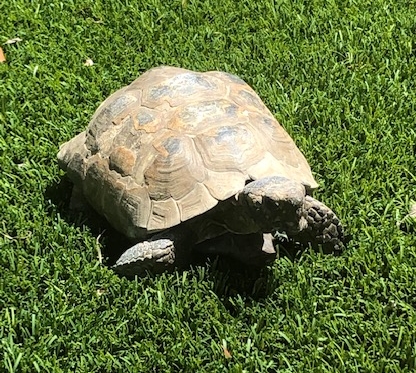
A desert tortoise named “Spike” has been a member of our family for almost thirty years. No, we did not purchase him or find him in the desert. One day, he simply came trudging up the sidewalk when my girls were playing out front. You can imagine their excitement when they brought him to me! Although we advertised for months around the neighborhood, no one came forward to claim him and so he stayed. Spike (so named because he liked to “spike” soccer balls) lives in our backyard from April to October and burnates (like hibernation) in our garage the other six months of the year. When he first comes out of burnation, he is sleepy and confused, much like Rip Van Winkle. But in the summer months, he becomes fully awake, is amazingly fast-paced, and chases us around, snapping at our shoes or exposed toes.

Living with a tortoise has taught me many life lessons over the years. His very “otherness” as a reptile is endlessly fascinating. Although his eyes look uncannally intelligent, his brain is downright prehistoric and he reacts to danger predictably. Provoked even in the slightest, he withdraws into his shell and will not come out until the threat has passed. However, when trust develops, Spike can be annoyingly persistent in his need to get my attention. I feel gratified when he comes running when I call him, when he follows me around while I do yardwork. I do not love it when he stealthfully sneaks up on me and wants to take a bite out of my flesh (believe me, it hurts) while I am meditating.

Perhaps the biggest lesson learned from living in close proximity with a tortoise is how similar we are despite our vast differences. Science has revealed that when human beings are threatened, a biochemical reaction takes place in the brain and we naturally assume a reptilian cold stance (or mind). That is, like the tortoise, we immediately withdraw to protect ourselves, escape down a trapdoor somewhere inside, and will not venture out again until the proverbial coast is clear. Unfortunately, even though this tendency can keep us from harm at times, it can also make us paranoid, an irregularity of the mind.

Interestingly, the first word in the synoptic gospels that Jesus speaks is the word “metanoia,” which turns out is the opposite of paranoia. Oftentimes we are taught that the word means “repent,” but the meaning goes far deeper than the idea of “paying back” what one has done wrong. The metanoia (meta = above; nous = mind) Jesus calls us to is a radical change of mind and heart. He tells us over and over with the actions of his life and death that we need to resist our reptilian impulses, get above our small-mindedness, and live open-heartedly in trust. This becomes problematic for most of us. In a sense, we have to consciously go against our natural self-preservation impulses to be true followers of Jesus. (Maybe that’s why many cannot really do it?) Too easily, we become hostile instead of hospitable; bitter and resentful instead of joyful and free of regrets. In the second half of life, we wrestle over and over with God, especially when something horrific like the deaths of innocent children happens.

Sometimes when faced with the darker sides of life, I feel just like Spike and want to simply withdraw until the danger passes. Unfortunately, that never happens for long on this side of the veil. More than anything, I do not want to end up a bitter old person barricaded against the world who cannot or will not face life in all its splendor. And so, I breathe deeply, pray daily, and force myself up and out of my reptilian brain. I stick my head out of its shell and follow the Light of the World, no matter the cost.

Hope Springs Eternal

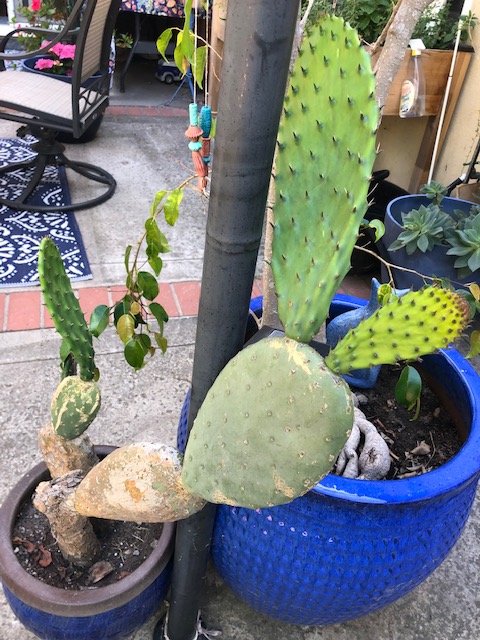
There it was, hiding behind an overgrown bush, covered with needles dropped from a towering pine tree: a brown prickly pear cactus planted in an old rusty coffee can. I found it last June, right before the grotto at St. Edward the Confessor Church was demolished to make way for construction. As some know, I was busy rescuing plants and statues from the wrecking ball in the Spring of 2021. I successfully saved most of the rose bushes and other plants but not the trees. During the last days, I sat under their branches and grieved. Maybe that’s why I took the dead-looking cactus home. It was just another loss I could not bear.

After removing the cactus from the coffee can, I was a chagrined to see that there was only about an inch of very dry dirt left. Doubt crept in. Survival after such extreme lack of sustenant soil or water seemed unlikely. Several of my transplanted rose bushes had died despite vigilant care. The remains of the beautiful “Yesterday, Today, and Tomorrow” bush I fussily transplanted is a now a lifeless tree in my backyard. Fearing the worse, I transplanted the cactus anyway, watering and feeding along with all the rest of my patio plants every month.

I waited and watched. I played classical music. I said prayers of encouragement but no sign of life appeared until one day after Spring arrived in Southern California. A small green bud suddenly erupted on the side of the seemingly wornout brown body. Within a few weeks, other shoots appeared and quickly grew into strong paddles. Like Lazarus in John’s gospel, the prickly pear had been resusitated! To me, this was a comforting affirmation of the Christ-soaked world that we are privileged to share. Who knows? Maybe I will be harvesting the prickly pear fruit at the end of summer and writing about them!

I realize that seeing a cactus come back to life is no big deal to most people. After all, I have read that they are remarkably resistant to abuse, easy to grow and propagate, especially the prickly pear. No matter. I needed that little signal of transcendence as the war in Ukraine drags on, the coronavirus mutates endlessly, and violence permeates the streets of our homeland. If the prickly pear can bounce back like that, I thought, so can we, again and again, as life demands. Nature reminds us so often that hope really does spring eternal. Even though we may appear dead, done-in or old, human resilience gracefully fuels rebirth.

True Guilt

“Catholic Guilt.” People always smirk knowingly when they hear this phrase that is equated with neurotic feelings about right and wrong. Older folks raised in parochial school, complete with sisters wearing habits armed with knuckle-cracking rulers, are amused or indignant about guilt. Younger folks see it as the detritus of the past and feel superiorly relieved that they are not held in its vice-like grip. However, mature seekers in the second half of life are often nonplussed by a reappearance of the dreaded feeling as they grow in spiritual wisdom. When a strong sense of conscience kicks into full gear, every troubling situation poses ethical questions that are difficult to understand, let alone answer.

The headlines of mass shootings this past week are a case in point. Personally, the news sent me into another tailspin of ruminations. The two men, a youth in Buffalo and a 68-year-old in Laguna Woods, could not be more different and yet their actions and motivations were similar. Fueled by rage and mental disorder, they killed the innocent, all in the name of doing what they convinced themselves was “good.” The losses are unspeakable. In the end, the survivors were robbed not only of their loved ones but also of their trust in a benevolent universe. Dark memories of a weekend in May will forever haunt their lives. Do the perpetrators feel collosol guilt and remorse for their actions? I fervently hope so but the hope does not release me from my sadness. Who is to blame for this senseless violence? For such outrageous behavior? Only two men? How will the scales of justice weigh the guilt and make us feel better?

I find it curious that whenever violence erupts in the world, complex emotions of rage, anger, sadness, grief, and yes, guilt arise strongly within me. Somehow, the responsibility on a corporate level for contributing to the evil in the world presents itself on a grand scale. The Spirit calls me to personal accountability and atonement for all my hurtful acts. I willingly respond because it is the only right thing I can do. True guilt convicts me in a good way and I am grateful that my faith has instilled this moral ground in me. But I am not neurotic about it. After seeking forgiveness, a sense of heavenly release descends slowly but never easily. I would rather take the righteous stand and blame others.

Figuring out true guilt from its neurotic counterfeit is like untangling spaghetti. Feelings, memories, experiences, and faulty theology hold many in a confusing quandary. Some people feel guilty about everything. More people refuse to feel guilty about anything, even when they have clearly done wrong. Others walk through life seemingly without a conscience at all, oblivious to what motivates them “to do good and avoid evil.” In essence, we learn these responses when we are young and spend the rest of our lives finding a way to deal with our human predicament one way or another. Although we hate to admit it, true guilt has kept us out of harm’s way more times than we know. But are we truly cognizant of that?

The only antidote to violence is nonviolence, that is, striving to live in a “do no harm” stance, no matter who or what we encounter. I really do believe that all acts of goodness help outweigh the injustices of this world. Just as evil is corporate, so is virtue but this requires us to choose language deliberately, act slowly and thoughtfully, and stick to high standards that make guilt kick into full gear when tempted. The challenge is tough and the cost is high but saving humanity from our own destructive tendencies is certainly worth it.

Broken and Beautiful

The second Sunday in May, Mother’s Day, never fails to stir reveries about my maternal ancestors. This past week, I have been dwelling on memories of my own mother and grandmothers and also pondering the great-grandmothers I never knew. Gathering old photographs, I set up a little altar laden with rosaries, jewelry, china, and bits of antique lace, to honor them. I lit candles and filled glass vases full of whatever was blooming in my flower garden.

Each year, I strive to affirm my daughters (all three are mothers too) of the unique power that the bond of maternity can wield in our world. Beyond blood, there is an inclusive love line that extends to all humanity, an extension of the “Holy Mother,” prescient and desired by everyone. She takes many forms– from fierce protectiveness like a lioness to quiet perseverance like a hen on the nest; from courageous refugee mothers to diligent hard-working moms who must multi-task like a juggler every single day.

I desire to remind all women, whether biology has made them mothers or not, that there is great strength when we bond together and stream this unique alchemy into the world. Unfortunately, culture often highlights our faults, sins, imperfections, and shortcomings until we feel paralyzed and broken. Ironically, however, this very brokenness often acts as a catalyst for the creation of something beautiful eventually to appear.

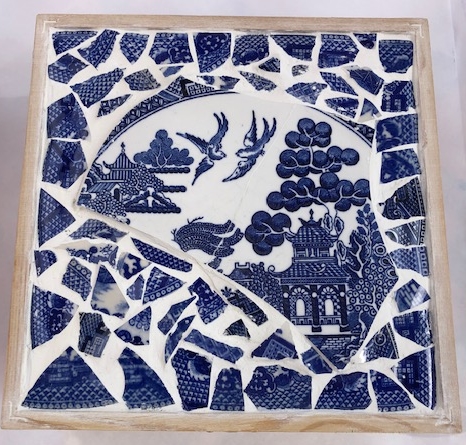
Out of these ruminations, I was inspired to rummage through my garage for a box containing broken pieces of the Blue Willow dishes I have used at my dinner table for many decades. I collected this pattern, one piece at a time, not only because I love the blue and white hues but also because I resonate with the story on each piece about transforming love (look it up and you’ll understand). Every time even a saucer cracked or broke, discarding the shards was unthinkable so I kept them, hoping I could perhaps make a mosaic someday. The time had arrived! I decided to learn this process (on YouTube) and give this gift to my daughters as a symbol of home, motherhood, and beauty from brokenness.

While I arranged the pieces, mixed the mortar, glued, waited, spread grout, waited yet again, and wiped off the excess, a sense of elation wafted through me. I wept over all the broken pieces of my motherhood that amazing grace has recreated into something new and beautiful. I felt the presence of our Blessed Mother, the many female saints, and most of all, the women who have been spiritual midwives for me and so many others, all around me. My hands were interwoven in theirs as I finished the projects, wrapped them in tissue paper, and wrote a little Mother’s Day poem for my daughters. The message for them, from me to you: We are broken and beautiful–both/and, not either/or!

May the Holy Mother continue to guide us in ways unexpected.

For God’s Sake

In the Midwestern Catholic home of childhood, my parents never swore or cursed in front of us. My French-Canadian mom especially abhorred profanity which she considered to be a sign of ignorance and language laziness. She substituted other words for common swear words (like “Oh fudge!” or “Shoot!”) which always slightly amused us kids. And when it came to using God’s name in vain? Under no circumstances was that acceptable. A slip-up sent us immediately to the Saturday afternoon confessional! If pushed to the absolute limits of their patience, my parents would often say, “For God’s sake, just DO it! (or STOP doing it). This would halt us in our tracks. There was no more ominous a request. The message was clear. If we couldn’t make a change for them or for ourselves, we were to change our behavior for the sake of the Holy One who gave us everything.

I do not consider myself old-fashioned or outdated but when it comes to language, maybe I am. I still cringe when profanity or the name of Jesus is dropped casually in conversation, in the media, in films, and on television. Worse is how easily it spills out of the mouths of the young in simple imitation of what has become commonplace usage. Others my age have shared similar family stories with me even though they, themselves, admit to having abandoned “clean” language as a spiritual discipline long ago. Who can blame them? Profane words are mere symbols of the frustrations and anger that are at an all-time high these days. What is troublesome though, is that we are no longer shocked by anything we hear. We have adapted to a “new normal” that does not elevate our minds, hearts, and words.

As a spiritual director, I talk to people all the time about God-consciousness and our struggles to make inner and outer lives match. Sincere seekers often feel ashamed of their scatological outbursts that seem to erupt out of nowhere. They want to control and change these impulsive tendencies, especially for the sake of the little ears that are nearby. There are, of course, ways to reverse these behaviors–like putting coins in a jar every time a swear word escapes. Sadly, this practice is often abandoned rather quickly unless a teenager in the family is put in charge of the jar. Sin and the fear of hell no longer motivate us either so I often hear myself saying what my mom taught me: “Can you just stop, for God’s sake, if not your own?” Cleaning up langauge may benefit ourselves and others but can we engage in better practices for non-utilitarian reasons? Simply to be true to the God within?

These are questions that can only be answered by trial and error, practicing, experiencing, failing, trying again and again. No one is perfect (another momism) but we can improve by taking small steps that lead to lifelong changes. Taking profanity out of our repertoire not only alters the way we speak but also shifts the way we think. The language of the Beloved then has a chance of transforming the world.

Do We Become the Mask We Wear?

Photo of a painting by Marilyn Zapp

For two years, we have hidden behind masks for health purposes. It has not been fun albeit necessary. All the while I have meditated daily on the consequences of blocking our faces, such important nonverbal communication indicators of feelings. I have especially lamented the detriment to small children and teens – not only the fear of other peoples’ germs but also the potential loss of skills in interpreting facial cues. Research for ions has revealed the importance of learning these skills as infants. My youngest granddaughter was born in September of 2020, at the height of the pandemic. In her first year, she was exposed to no one without a mask (except immediate family members). I constantly fretted, along with my daughter, and we made a constant effort to emote unmasked when in the confines of home. Even though she seems very well adjusted 19 months later, I still wonder what has been lost. But masks have always been a constant source of contemplation for me.

In summers long ago, I took my girls to the Sawdust Festival in Laguna Beach. It was a pilgrimage of sorts into the world of local art and hand-crafted treasures. On one such visit, I became enthralled with a painting of a young woman holding a mask by artist Marilyn Zapp. Both the mask and the woman are crying. Underneath is an inscription: Do we become the mask we wear? Then, having just facilitated youth retreats exploring the false and true self, I felt compelled to purchase the painting. It has hung in my office ever since and I have used it as a springboard for many interesting discussions.

This past weekend, I spent a day of retreat with my 15-year-old granddaughter, Elaina, who celebrated the Sacrament of Confirmation yesterday. Because of the pandemic, her two-year preparation was conducted wearing masks at all times and did not include an overnight retreat, often a highlight for many teens. Even though having a one-on-one with her grandmother could hardly compare, she sweetly accepted my invitation and we had a treasured time together. We talked a lot about masks, not only the PPE ones she had to wear the first two years of high school but also the invisible, psychological survival masks we think we have to wear to be accepted. I asked her to select magazine photos to represent the different masks she wears with friends, parents, herself, and God. Then she arranged them in a collage on a paper mask. Her photos were touching, revealing, and poignant; the discussion honest and deep, much more symbolic than the medical mask, which she said she was “used to,” and “did not mind.” I marveled at how adaptable we all are and cried inside about that reality.

Once again, masks are back in the news cycle, filling us with confusion, anger, and fear. People are so divided over this issue! Elaina and I ruminated over why we are not more concerned about the fake masks we are forced to wear every day. As my painting reminds, if we are not careful, the false self does become what we think is our true self. A tragedy. A lie. The true self, often hidden, dormant or disguised, is the innate “image and likeness of God,” the “Christ within,” emanating from every soul, the love that binds us together for eternity, the in-dwelling of the Holy Spirit. As I told Elaina, it will take us a lifetime of diligent effort to shed the masks of the false self and allow the Christ within, the true self, to stream out into the world. But it’s worth it!

Rising

HAPPY EASTER SEASON EVERYONE! The rising cycle of the Paschal Mystery is upon us now as we celebrate for fifty days (until Pentecost). Doesn’t it feel glorious? My bearded irises, calla lilies, rose bushes, and geraniums are blooming. Along with Jesus, all the earth has risen to new life. Likewise, my engagement with Lent has ended and now I am joyfully embracing this Spring season with a renewed and intentional gusto. I began on Holy Saturday by making traditional Easter bread for my family to share, a sacramental gesture of gratitude for the gift of the resurrection.

I have been baking bread for fifty years–for holidays, special occasions, and little presents for bread lovers. My fascination with the whole process started because my mother baked bread and simply, I loved to eat it! It was crusty on the outside and sweetly tender on the inside. Even the best bakery in town could not compete with it. Spread with butter and jam or peanut butter, it never lasted more than one day at our house. When I moved far away from home after I married, baking bread was one of the first culinary adventures I undertook. As simple as the ingredients are, the process was one I learned to respect. From the mixing of flour, yeast, and warm liquids, there was kneading, and diligent waiting for the dough to rise before baking. The end result still seems to me like a little miracle.

These days, it is important not only to look for little “resurrection” miracles but to participate in them as well. The world situation can be infinitely depressing if we cannot see through lugubrious situations with a mystic’s eyes, with a “faith that looks through death,” as the poet wrote so long ago. In Christianity, what looks like death/defeat is really life/victory. Every moment is paradoxically meaningful when we rise from our banal, cynical, false self tendencies. In essence, the resurrection teaches us that holding the tensions of life can be endured with the gentle hope of rising again.

Everyone “ooohed” and “ahhed” when they beheld the loaves of Easter bread set as the centerpiece of our family table on Sunday. In between my grandchildren’s egg hunts and the many lures of peeps, chocolate bunnies, and jelly beans, we tacitly became the Body of Christ when we broke bread together and humbly remembered why we gather on Easter in the first place. Rising to the occasion, we were aglow with bonds of generational love that we then streamed out into a world in need. I hope you felt it.

Stones Crying Out: Lent Week 6

The drama of Holy Week always takes my breath away, beginning with the gospel story that recounts the scene of Jesus’ triumphant entry into Jerusalem. Suddenly, the Messianic secret is out and everyone enjoys a collaborative “epiphany moment,” with the realization of Christ’s true identity. The apostles are appalled when a huge mob crying “hosanna” and waving palms in homage follows Jesus, riding on a donkey, into the center of the city. Peter, James, and John must have been wringing their hands in worry. The last time they were there, people nearly lynched Jesus. Making a big fuss would most certainly put them all in harm’s way. But when the apostles tried to quiet the crowd, Jesus protested saying that if they were silenced, the very stones would cry out!

Jesus’ reference to stones crying out always gets to me. I have “a thing” about rocks anyway, as most of my friends know. These solid, inanimate objects speak to me especially when I walk on the beach. Heart-shaped rocks leap out like valentines. Smooth white pebbles gleam like peppermint jelly beans. Turquoise, orange, and copper-hued stripes shine brightly when drenched with saltwater. This time of year, they look like Easter eggs and I fill my pockets full. I know God has lots of rocks and does not mind if I relocate a few to the Medicine Wheel prayer circle in my backyard or give them away to friends who also appreciate what lies in plain sight beneath our feet.

Sometimes big boulders even cry out “hosanna” as seen in this photo I took of three perfect white crosses that seemingly appeared out of nowhere. When folks express worry that our world is trying to erase the Holy One’s presence, I assure them not to be fearful. The Creator will not be silenced. If you don’t believe me, read the gospel for Palm Sunday. We have the word of Jesus on this topic.

The Triduum (three days preceding Easter) is in our sight now. I am easing into these momentous celebrations with eager anticipation and calm. Usually, this is the busiest, most stressful time of year for me. But now that I am retired from professional church ministry, I am happily anticipating the celebration of the Paschal Mystery in a new and different way. On Holy Thursday, I will wash and kiss the feet of folks in need. On Good Friday, I will ritually pour out lamentations for this suffering world and venerate the cross with like-minded friends. On Holy Saturday, I will bake Easter bread and wait at home, tomb-like, for our family celebration on Sunday, another glorious resurrection amidst the messiness of life. All the while, my ears will be attuned to the subtle whispers of the stones, flowers, plants, and ocean, that fill my soul to the brim with everlasting hosannas.

Alive Again: Lent Week 5

Since March of 2020, the reality of death has been literally in our faces every single day as we constantly engage with the tragic pandemic stories on the news. Yet, coronavirus is not the only reminder of our mortality. There are natural disasters, school shootings, fatal accidents, other diseases, and most recently, the war in Ukraine to remind us that life on this side of the veil is fragile. While we live with the certainty that no one gets out of this alive, most of us remain in denial, shocked at the death toll, believing somehow that we are all supposed to die peacefully in our sleep at age 100. In reality, this is an uncommon experience and found nowhere in Scripture.

The Gospel for the Fifth Week of Lent, Cycle A (the RCIA readings), the story of the Raising of Lazarus leads us ever more deeply into the mystery of life, sickness, death and resuscitation. This confounding narrative could be the source of a lifelong “lectio divina,” there are so many quirky details. Lazarus and Jesus are best friends, something we did not really know much about before this story. Lazarus falls fatally ill (think of someone in ICU with Covid) and although Jesus is told to come right away, he takes his sweet time getting there. Lazarus is dead and in the tomb three days before Jesus finally arrives. He seems utterly surprised, weeps copiously, and then performs perhaps his greatest miracle: he calls Lazarus back to life. The story ends there but I always wonder what Lazarus said to Jesus at dinner that night.

A happy ending to the finality of death is also at the heart of the Paschal Mystery with the resurrection of Jesus. Holy Week is coming soon and we will be plunged again into pondering why Jesus chose to endure enormous suffering, horrendous torture, and humiliating execution before he spends three days in a tomb and is resurrected. I never look forward to walking through the gulf of grief and lamentations on Good Friday and Holy Saturday but by Easter Sunday, I am always grateful for this sacred journey, fraught with lessons about dying for love and holding the many sorrows of everyday living.

This past week, I attended the musical “The Secret Garden” produced by the young thespians at Santa Margarita High School. Like many of you no doubt, I had read the book by Frances Hodgson Burnett when I was very young and had always loved the story. Since the play’s Broadway debut in 1991, I had longed to see the theatrical adaptation on stage and was not disappointed by this stellar production. (I am always astonished by these talented young artists!) As the story goes, the unresolved grief in a family locks the door to beauty, preventing the living and the dead to move on. Then, quite by accident, a lonely, grief-stricken little girl with resilience and tenacity, finds the key that opens the door to a secret garden that has grown fallow. Love awakens the dormant plants, brings technicolor to the flowers, and heals the brokenhearted. Out of death, life comes forth, unbound, like Lazarus, alive again; like all who make their peace with the cycle of death and rebirth.

Oftentimes, when sickness or death invades life, people of faith question how those without spiritual inclinations can endure its ravishing effects. How indeed? Right at the top of my list of spiritual questions for God has always been the same one: Why do we (or anything really) have to die? Only in the silence of meditation each day can I even begin to release such queries and embrace the birthless, deathless Christ who lives hidden inside the secret garden of each human soul. Only then am I surrounded by the communion of saints and angels, still with us, alive again in every remembrance.