
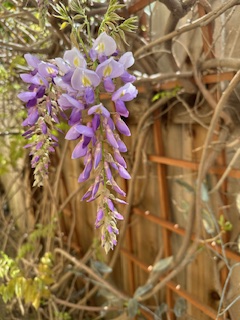
Wisteria is blooming outside my kitchen window again. The delicate, light purple blossoms and mint green leaves suddenly appear each year as if out of nowhere, perfuming the air and immediately uplifting my soul. How I love these signals of transcendence! They ignite the embers stirring deep within and connect me instantly with the Sacred Presence that forever dwells at the ground of all being.
Especially during Spring, finding God in everything, everything in God provides a rich banquet of sights, sounds, smells, savors, and stimulations. Allowing the imagination to run wild, there are endless delightful ways to encounter and experience the Divine in natural settings. Yet these insights sometimes startle people. Someone once told me that such an approach is “too easy, too good to be true.” Others question my orthodoxy and warn against pantheism, worried about my faith and ultimate salvation. I get that. Most religious people find great comfort in strict adherence to creeds, and what they deem “right belief.” They feel compelled to correct anyone who waxes poetic about encountering God in wisteria.
But I know I am in good company. Many great saints believed and lived an incarnational faith: Francis of Assisi, Julian of Norwich, Ignatius of Loyola, and Hildegard of Bingen, to name a few. To them, and many others, we live in a Christ-soaked universe; we float on a river of divine love; we walk on sacred ground right where we are. Defined more precisely as “panentheism,” this approach provides an expansive view of faith that includes the enlightenment of both Scripture and Tradition.
Professor and author John Caputo writes eloquently about this vision in his many books on philosophy and religion. He proposes that we try to “believe what we love,” rather than “love what we believe.” While his challenge may resonate on a primordial level, what does he mean exactly and why do so many hesitate embracing such an approach?
Cognitive dissonance rises from our need for concrete reassurances about the Divine rather than “mere” symbols and metaphors from the natural world. Yet, when we try to put skin on God, symbols and metaphors (including words, the arts, and natural wonders) comprise the only tools we possess. And they are very powerful! Who among us has not been profoundly moved by a magnificent piece of music or literature? A rainbow? Moonlight shimmering over the ocean? Why then do we often say “it’s just a symbol”? As long as we remember that the symbol only points to the real thing, and is not the thing itself, we can believe in what we love without worry.
As I gaze at the blossoming wisteria each day, my thoughts again return to the Paschal (Easter) mystery: Life-Death-Resurrection-Ascension-Pentecost. No matter how down and out life seems at the moment, we will rise again and soon will ascend into the clouds. Before we know it, warm summer breezes will carry us on Spirit’s wings to new fullness. Then the cycle repeats, on display through every season of life, until the end of time. Belief in the Paschal Mystery, the foundation of my faith, is not simply an intellectual exercise, nor an emotional high, but a practice that changes ordinary moments into sweet-smelling, purple miracles right outside my window.
 Seeking Wisdom
I believe in both thoughts of the Divine..nature/Church symbols & religious arts. Pretty sure you do too, bc God is infused in all you mentioned. I was just listening to Byran Johnson, who gave up his Mormon religion & faith in God to put all his energy into not dying. No Eternal Life beliefs for him, no proof he said..didn’t even mention the Resurrection! Never would I turn on Jesus to live forever, but I do my best to honor my body as to stay healthy for myself & my family. Easter is about blossoming 🌷🪻🌻 & rejoicing, just like your lovely Wisteria blooms!
LikeLike