
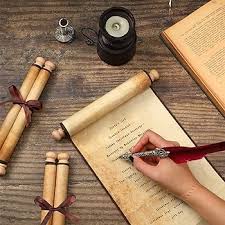
Recently, at the request of a dear friend, I became a temporary scribe for a week. Maybe not quite of biblical and monastic levels, but equally challenging. Would I calligraphy a wedding toast on a parchment scroll for her grandson? I was immediately intrigued by this out-of-the-blue request. One of my big laments these days opines over the demise of handwritten anything. Misgivings immediately arose since my hands are not as steady as they once were. The spirit was willing, the flesh weak. Nonetheless, out of sheer love for my friend, I pushed aside my frailties and took on the task.
I became fascinated with hand-writing as an art form when I was quite young and would amuse myself by copying Old English script, modern block letters, and finally the art of calligraphy before “font” became everyday jargon. My vast collection of fountain pens and nibs occupies a whole drawer in my desk. I love the smell of bottled ink in the morning! Throughout the years, people frequently affirm my handwritten cards and notes. “I wish I had a pen that could write like that,” they exclaim. While I could easily supply one, a person who can push that pen is also required. Ah, there’s the rub. While professional calligraphers skilled in this technique still exist, amateurs like me are apparently a dying breed. When was the last time you received a beautifully hand-written anything?
Eagerly, I set up my drafting tools–rulers, pencils, erasers, and a splendid array of pens and ink bottles. Maybe I should don a cowl and robe, I thought. I laughed aloud, picturing monks in monasteries hunched over ancient scrolls. Instead, I utilized technology and made a playlist of meditative music to help me concentrate. The toast, emailed to me, was four pages long, single-spaced, and in 11-point font. Yikes! I copied it into a Word doc to calculate the number of lines needed, how many words would fit on a line, etc. The preparation alone took many hours. Meanwhile, the weather turned HOT. I set up fans since we don’t have air-conditioning in Dana Point and wrote multiple paragraphs on scrap paper for practice. Like an Olympian, I knew I had only one shot. The margin of error was high and there was no turning back once begun.
Since large wooden dowels were affixed to the scroll on each end, I stood up to do the calligraphy. I often paused to stretch my back, shake out my legs, and breathe deeply. Copying a document word-for-word poses a unique challenge beyond the physical demands. What do you do with lapses in concentration when words are misspelled, left out, or inserted? Human error! I had to create new words, edit nonsequiturs, and figure out how to disguise lettering mistakes. An artist friend reminded me that the beautiful illuminated medieval manuscripts covered up a plethora of human errors so I did not feel so bad.
The experience also gave rise to daily meditations about our ancient, sacred sources and the amount of time and ink spilled by scholars arguing over translations and interpretations of the early texts. What influence did the scribes have in what eventually got written down and later taken by some as literal truth? Who were the “fact checkers” in the scriptoriums of yesteryear? A previous realization about Divine Revelation recurred. What we ultimately believe about Scripture, inspired by words written long ago in dimly lit rooms by well-meaning but very human artists, comes down to a leap of faith, tested by experience, known more in the heart than in the head.
When I finished the calligraphy, I was relieved when the number of calculated lines fit the manuscript nicely onto the five-page scroll. I was simultaneously dismayed over the mistakes, smudges, and lettering flaws that leaped up at me. My heart sank. Was this good enough? When I conveyed my misgivings to a friend, she reassured me. “That’s the charm and beauty of what is hand-done. Trust the Spirit. That’s what the early Scribes did when they embraced this human and divine work.” I felt an instant resonation stir within me. In our current culture of AI, fake news, and a veneer of perfectionism on social media, nothing can replace the sacramental, incarnational nature of the human touch, flaws and all.
Scribe for a week left me humbly grateful. The process, despite my woefully inadequate feelings, provided yet another chance to exercise my both human (in execution) and divine (in intention) nature. Turns out, the scroll, a gift for someone I have never met, became a gift for me, full of insights and meaning. What could be better?
 Seeking Wisdom
What a beautiful journey! Thank you for taking us with you!! Your musings evoke thoughts I would never have explored without your taking us on this experience with you Donna! Blessed me today!!!
LikeLike
wow!! 23Scribe for a Week
LikeLike